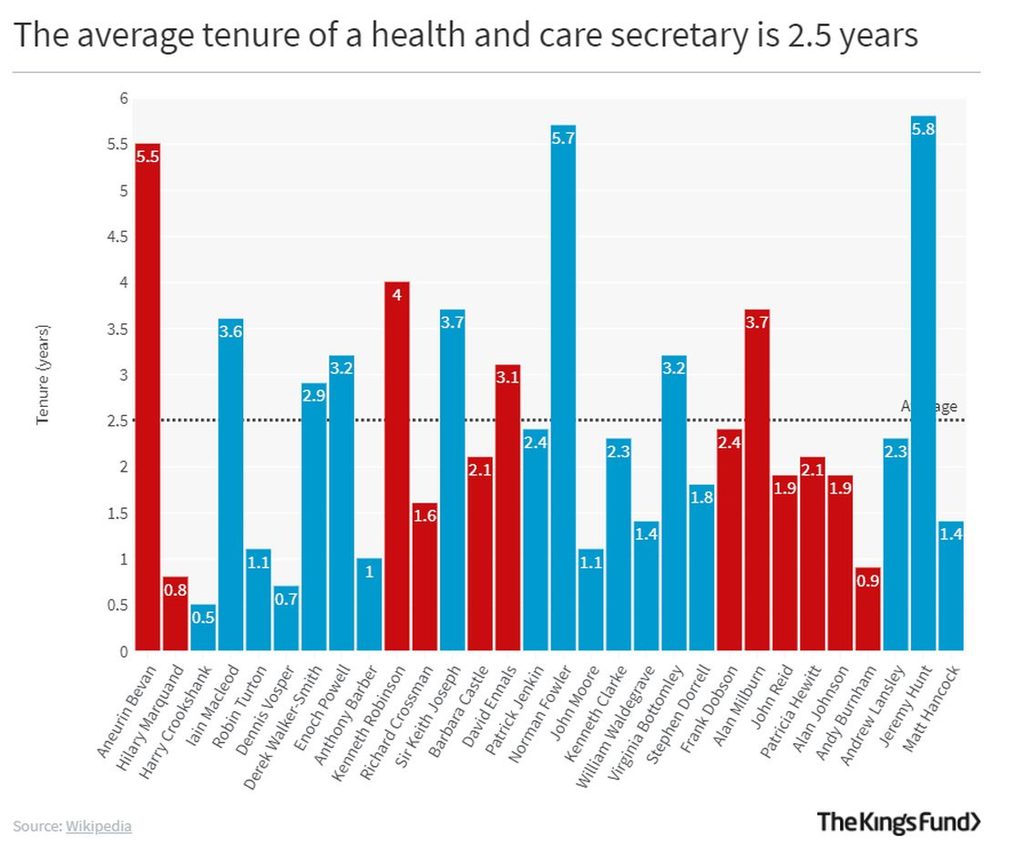
The Political “Merry Go Round” – See Chart of Health Ministers (Sorry, ran out of space for the eight further changes we have had since 2021!) Note, with the glorious exception of Aneurin Bevan, it should not be assumed that longevity of itself is the answer. Also Prime Ministers rarely get involved. Too driven by “events”, PMs usually try to delegate Health to a “trusted” colleague in the hope of avoiding the headache. Twice PMs have realised that the direction of change was not right and twice they were too late to intervene (Mrs Thatcher with Internal Market, Mr Cameron with Lansley Reforms)
First, the Technology – Probably this has the greatest potential to make change for the better and quickly. Mr Blair’s attempt to build a national model collapsed at a cost of £12billion in 2012. And since then? What is the scale of the damage to effective co-ordination as a result of all the changes and fragmentation? And it is ongoing. We started with 42 ICBs in 2022 and in 2025 the decision was made that number should be halved. It is still not clear what the final number will be? More cost being incurred, more time being wasted, trying to integrate systems which may not be ideal in the first place. How far behind are we?
The Fragmentation – Essentially down to the creation of the “Internal Market” from 1992 onwards with the split between the Purchasers (GPs) and the Providers (Hospitals and Community Care) Never worked from the start. No “virtuous” competition created. 30% of allocated funds lost in transaction costs, as happens with Health Insurance Systems. Yet it took 25 years before first actions taken to dismantle it. AND it is still not finished. That Split, potentially fatal, between primary and secondary care remains.
The Restructuring Failures – Primary Care Trusts. Clinical Commissioning Groups. 300 new NHS admin/oversight bodies created in the 2012 Act. NHS England failed, Healthwatch failed, Local Government input failed, Care Quality Commission failed. And now ICBs? To date, much easier to list their differences than any achievements. It cannot help that the boundary lines between ICBs are essentially artificial. Are there really any regional health differences between say Herts and Bucks, or South and North Cumbria? Yes there are significant inequalities across England, but these are much more easily dealt with at a local level.
The Contracting Out Failures – In theory no reason why the NHS should not exploit its world-beating “Health Monopoly” status. In practice it is not working. Darzi Report (the second one!) states “The function and authority of ICBs remains unclear in some important respects. The 2023 Hewitt Review was unable to clearly define the relationship between providers and ICBs, and the ambiguity persists” In other words (!) we, the taxpayer, the NHS Purchaser, do not know what we are paying for! Worth reflecting on this each time we are invited to listen to commentary from a spokesperson from the NHS Confederation or the NHS Providers? This also has consequences in failing to exploit opportunities on a national level. In 2004 the National Audit Office reported that the NHS was throwing away well over £500m per year in failing to maximise Economies of Scale. Must be many £billions each year by now.
The Hospital Trusts – Note Mr Blair’s ultimate model was that all Hospital Trusts should develop into Foundation Trusts. Problems! All further extension of Foundation Trusts was halted in 2016. Is the Trust model viable? First the finances. At the onset of COVID HM Treasury had to give an immediate £13 billion bail out to Trusts to write off their debts. These debts have quickly returned and persist. Second the standards of service. There is no direct accountability of Trusts to the communities they serve. To quote Darzi again “The only criteria by which trust chief executive pay is set is the turnover of the organisation. Neither the timeliness of access nor the quality of care is routinely factored into pay.” The general public hold NHS staff in full esteem and rightly so, yet so many people now know someone among their family, friends and colleagues who have had a poor experience in hospital. Consistency of quality service has been lost and unease is growing. This is exacerbated by the recurrent “scandals”. The Mid Staffs Trust Elderly Care scandal of 2009 was supposed to be a “Never again” event. Sadly this has not happened. Major failures continue, as revealed only last month by Maternity Care at Nottingham University Hospitals NHS Trust. We are never short of political outrage and enquiries afterwards, we are always short of ongoing consistent, rigorous scrutiny to prevent such lapses happening in the first place.
The Focus on the Short Term – Target setting remains a favourite tool of all the political parties. In reality they are rarely effective and much more likely to be counter-productive; a distraction for NHS Staff with more time and effort wasted in responding to political demands rather than patient demands. Target setting is particularly ineffective in driving improvements for the complex issues. Mr Blair was the first to set targets for A&E and what has that achieved? So many targets that the General Public have long lost all faith in them, yet our politicians persist.
The Absence of Long Term Planning – The list is long. To make a start :- Technology, Number of Hospital Beds, Provision of Diagnostics, Infrastructure maintenance, New Buildings programme (Ironically a glimmer of light here? It was an established fact that if you lived in a marginal constituency, you had far better chance of having new hospital investment. This will end; but only because it is becoming very difficult to identify a marginal constituency!) Serious lack of foresight in NHS Staffing planning at all levels – senior nursing staff? number of GPs? ongoing resident doctors dispute …and so much more.
And GPs? – There have long been pressures but there seems to have been a marked deterioration since Covid in the circumstances in which GPs find themselves working. How many distractions from their core job have been put in their way? Much of this can be traced back to Mr Brown’s rewriting of GP contracts in 2004. And the impact on patients? Ongoing difficulties of access. Major inconsistencies between GP surgeries, even in the same locality. More inequalities.
The Total Cost? – Mr Blair’s Private Finance Initiative is often quoted here. The excessive interest payment charges have been calculated as totalling £80b and the NHS is still trying to pay them off. But this is only one example among so many. It would probably need months/years of a Ph D study to work it all out. Perhaps a reasonable estimate is that in the last 25 years, the total amount of taxpayer money wasted could well be £300 billion plus. And ongoing? Again it is reasonable to say this could be running at between 10/15% of the total NHS Budget, around £30b this year. Note all that is but a cautious stab at measuring the financial cost of all the damage caused by politically driven wrong decisions.
The negative impact on so many individuals working in the NHS; their morale, development, motivation and so much more, is IMMEASURABLE.
The Key Question – Do we let this continue?
For the first 25 years of the NHS there was a total absence of any political controversy. In the last 40 years the NHS has been pushed deeper and deeper into the political mire. The result is 40 years of serious mismanagement of the NHS by successive Governments. The political outlook is not promising. At best it is uncertain, and no matter who is in power, finances have never been more constrained. Continuing as we are, leaving politicians in charge, is there any hope
for the future of the NHS? NB Please note this is not a blanket criticism of our “politics”. After all we elect our politicians! Our Democracy requires them; they are there to attempt to resolve issues where we have our differences. But this does not apply to the NHS. 90% of us agree on the fundamental principles of the NHS, we just need it run better.
With some imagination we can find a much better way. The key step is to eliminate the damage of misguided, short term political interference. It will take time, we are unpicking the consequences of 40 years of disease. But it can be done and done whilst still keeping full democratic control. Indeed, we can strengthen our Democracy during every careful step of the way.
All we need is confidence in ourselves. Thank you.
Graham Cartmell